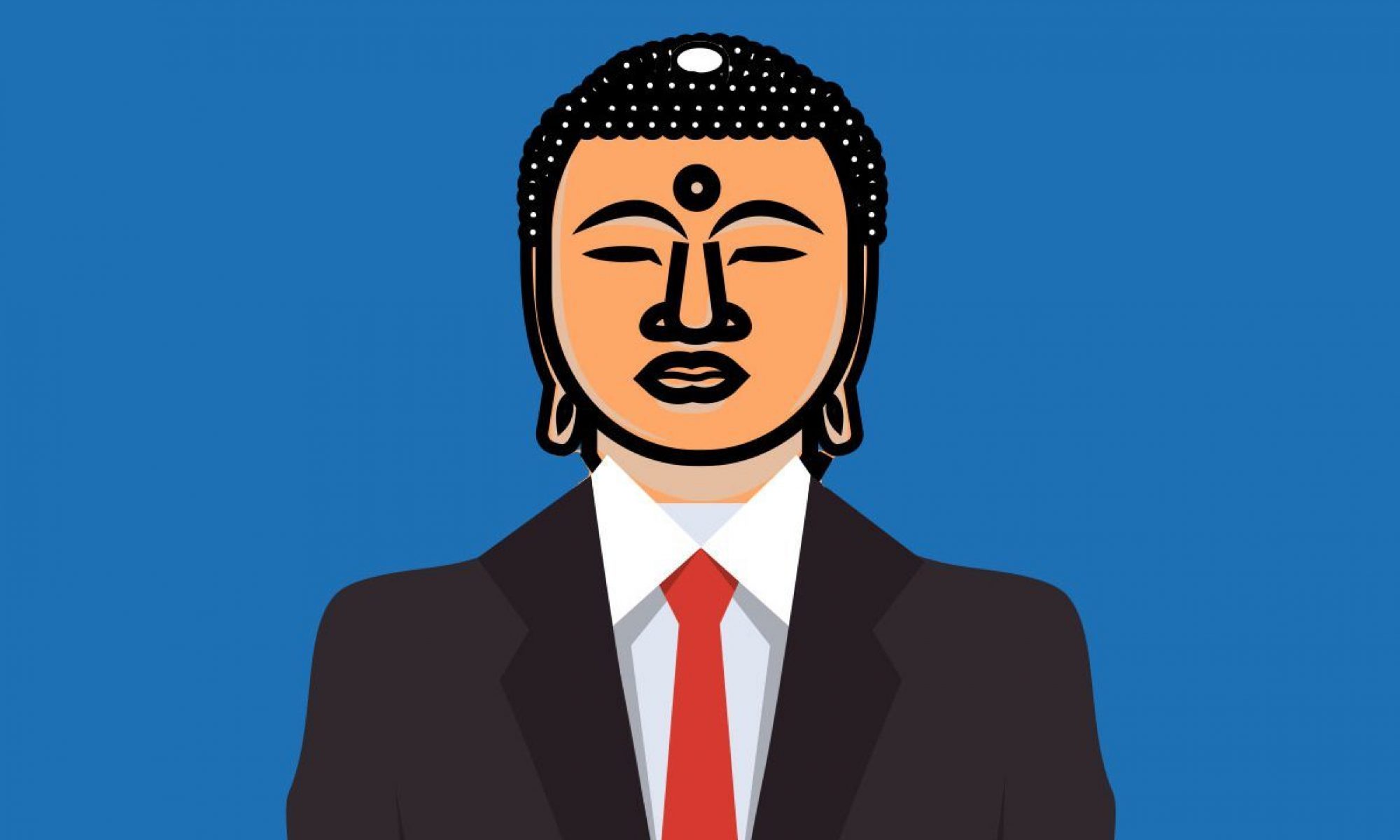
Dao Du Jour, Day 75: Alone Together

Chapter 75:

“When taxes are too high,

people go hungry.

When the government is too intrusive,

People lose their spirit.

Act for the people’s benefit.

Trust them; leave them alone.

~ Stephen Mitchell (trans.), Tao Te Ching: A New English Version (New York: Harper Perennial), 2006.


Do not be misled: the Dao is not a supporter of the GOP. For one thing, the cult of individualism that is the bedrock of modern conservatism—and classical liberalism more broadly—is alien to Asian cultures generally. Part of this passage, especially the notion of an intrusive government, is a dig at Confucianism, the original “Big Brother” of antiquity, but Daoism still embraces a relational view of humanity and reality. Lao-Tzu’s point is that that at some point, rules become not only restrictive and oppressive, but insulting to people’s intelligence and disrespectful of their humanity.

But if he were around today, Lau-Tzu would hardly be praising the cult of the entrepreneur, advocating trickle-down economics, or dancing the Republican two-step of cutting taxes and slashing regulations. We often assume that what we call neoliberalism is premised on “free markets” and deregulation, but as Quinn Slobodian documents in his book on the topic, neoliberalism was actually about re-regulation and “encasing” markets in a legal and political architecture that resulted in the dizzying levels of inequality we see today.

What that means is that, paradoxically, in order to “leave the people alone” in today’s age, government is not the problem but the solution. Taxes must be raised on corporations and the wealthy because “taxes are too high”—not marginal tax rates, but the increased cost of living for the average person in terms of education, healthcare, and housing, combined with stagnant wages. For the longest time, we have mistaken “government intrusion” for something called “late capitalism,” forgetting that economic waves, however driven by powerful global currents, are downstream from politics to the extent that the decisions leaders make determine how nations surf them. In perhaps the most contorted ideological pose conceivable, the notion that capitalism is the problem is a kind of ideology that masks the real threat: a misunderstanding of the optimal relationship between politics and economics, between democracy and capitalism, and of the true nature and proper role of values in determining the shape of society. The tectonic shift we are just beginning to undergo away from Reaganism and toward a “New New Deal”—one more racially inclusive and environmentally conscious than the original—is a return to values-based governance, and a rejection of the fantasy of value-neutral public policy, which neuters the people’s will and neutralizes the very idea that there is such a thing as society.

To act for the people’s benefit, remember there is such a thing as the common good.

To trust them, decouple welfare from work.

To leave them alone, pass laws as if they aren’t.


New to the Dao Du Jour? Check out “Day 0.”

Dao Du Jour, Day 74: Ministry of the Future

Chapter 74:

“Trying to control the future

is like trying to take the master’s carpenter’s place.

When you handle the master carpenter’s tools,

chances are that you’ll cut yourself.”

~ Stephen Mitchell (trans.), Tao Te Ching: A New English Version (New York: Harper Perennial), 2006.


Stoicism and Daoism are often accused of fatalism: the Logos and the Dao are going to do what they’re going to do, and you’d best accept it rather than “push the river.” Go with the flow and like it! This offends our modern Pelagian sensibilities and, indeed, it is puzzling that Stoicism has become so trendy in contemporary self-help culture. If the lion’s share of self-help literature is based on so many versions of “the power of positive thinking” and the “law of attraction,” Stoicism might be cast as “the power of negative thinking,” or as Tim Ferriss puts it, “practical pessimism.” Something like a “law of subtraction” is contained in Lao-Tzu’s prescription for gaining wisdom: “subtract something every day.” For the Stoic, we must try not to control what cannot be controlled; for the Daoist, we must try not to try doing anything.  

But ceasing our attempts to control the future doesn’t mean writing the future off. It means changing how we relate to it. In the spirit of Stoicism, Stephen Covey, author of the 7 Habits of Highly Successful People, introduced a useful framework for positing ourselves relative to the future. The individual is placed at the center of three concentric circles. The first is the circle of control. The second is the circle of influence. The third is the circle of concern. Obviously, the optimal allocation of your attention involves is to maximize focus on what you can control—e.g., how much sleep you get tonight—and minimize focus on what you’re concerned about—e.g., the prospects for peace in the Middle East—while devoting a decent amount of energy toward influencing those around you—e.g., friends, family, and colleagues. If you focus too much on what you’re concerned about, you’re going to “cut yourself.”

If we layer the circle of Hierocles on top of this one, and set it in a temporal context, interesting things start to happen. In this framework, the circle of the self is nested within progressively larger circles—family, community, nation, etc.—extending to humanity itself, the cosmopolitan perspective that the Stoics introduced into Western culture. Today, we would include an even more encompassing circle—the environment and nonhuman beings. The adage think “globally, act locally” tracks this idea—we should attempt to control and influence ourselves, others, and the world in ways that are aligned with global concerns. But when we add the temporal dimension, it gets more complicated.

In her new book, Under a White Sky, Elizabeth Kolbert grapples with precisely this question of how we are to relate to the future. The Baconian ethos of controlling nature to relieve the human estate, so successful in some respects, has generated a surfeit of social and environmental problems that threaten to do our civilization in in the long run. But exactly because of that success, it is tempting to think that by doubling down on control, we can fix these problems. If that modern vision was about gaining knowledge to control nature, the 21st century version of it will be about gaining knowledge to control the future. Kolbert, channeling the world-weary cynicism of many an environmentalist, sighs that all we can hope for is to “control our control of nature.” It is not a matter of whether we will be gods, but what sorts of gods we will be. Yet this position seems tragic: we are destined to death by 1,000 “cuts.”

But the apprentice carpenter is prone to error not just because he doesn’t know how to use the master’s tools, but because he doesn’t’ know wood. A master is a master first of all of his material, not his tools. The tools are a means toward revealing the shapes that slumber in the wood. He does not so much impose a pre-existing form in his mind on the blank canvas of the wood; he draws out the forms suggested by signature of the wood, and the tools are like different moves in the dance he leads it into.

The modern project has in large part been about treating nature—the wood—like a blank canvas that we can pain anything on—that we can turn into any shape we damn well please. It encodes an attitude toward the future that is fundamentally escapist: the earth is something to be not just used, but used up, and the future is regarded as an otherworldly paradise, freed from the laws and limits of this vale of tears. The future is something to which we wish to escape.

But our civilization is undergoing a tectonic shift in our relationship not just to the planet, but the future. Just as we must begin to think more globally, we have to think in longer time horizons. Luckily enough, our species is pretty good at this: indigenous and traditional cultures always played the long game. The difference is that they played the local game, not the global one. Our task, then, is truly new: to play a game both long and global.

The future is not something we can the ability or the right to control. It is something we have the ability and the responsibility to protect. We must trust that the wood—the natural world—will tell us how to redesign our civilization so that we can develop the tools necessary to bring it forth. The endgame is not escaping the earth, but learning how to be earthlings.


New to the Dao Du Jour? Check out “Day 0.”

Dao Du Jour, Day 73: Web 3.0

Chapter 73:

The Tao is always at ease.

It overcomes without competing,

answers without speaking a word,

arrives without being summoned,

accomplishes without a plan.

Its net covers the whole universe.

And though its meshes are wide,

it doesn’t let a thing slip through.

~ Stephen Mitchell (trans.), Tao Te Ching: A New English Version (New York: Harper Perennial), 2006.


To see what is in front of one’s nose, George Orwell put it, is a constant struggle, and perhaps the hardest part of that struggle, the hardest thing to see, is technology. Why? Because it is more and more provides glasses through which we see. As Heidegger put it, the essence of technology is nothing technological: instead, it’s a way of understanding reality, a way that we are typically blind to.

If we consider how dramatically the printing press changed the course of world history over a few centuries, and how early we are in the days of what is probably an even more transformative shift in our information ecology, we can slip through the grasp of our current social imaginary, confident that it too shall pass. Where the early days of the world wide web were utopian, the second act of the internet has been characterized as the “techlash,” a bevy of concerns about the harmful psychological, political, cultural, and economic effects of Big Tech. Both stories were apocalpytic: where Web 1.0 was seen as ushering in a kind of libertarian socialist [sic] paradise, Web 2.0 is seen as leading us toward, alternatively, an idiocracy and/or an authoritarian surveillance superstate, or what Jaron Lanier calls “Digital Maoism.” The former story has been reincarnated as the Singularity, aka the Rapture for Geeks, while the latter story has been variously depicted in the series Black Mirror.

What would Web 3.0 look like? As with any technology, over time the internet will become more and more integrated into the lifeworld; indeed, that process is already proceeding apace, as we see in the so-called Internet of Things. Right now, we are still adjusting ourselves psychologically and culturally to the new tech, and are beginning to realize we must adjust the new tech to accommodate the neurobiological limits of our organisms. But when our self-conceptions and social norms and political and legal systems are still running the old software that codes the human being as a separate, solitary, sovereign individual—the anthropology of classical liberalism—the internet will present as, alternatively, deliverance from isolation or a threat to freedom.

Seen properly, the internet encodes the same big idea as ecology: that reality is a fabric of relationships, not a collection of atoms. Nature and technology—and we must not forget that nature produced technological beings—are guiding toward an understanding of our place in the universe captured not just by the Dao, but the image of “Indra’s Net” from Hinduism: a vision of the universe as a web, with each node a jewel that reflects the whole. Each is a part of the whole, but the whole is contained in each part.


New to the Dao Du Jour? Check out “Day 0.”

Dao Du Jour, Day 72: On Magma and Dogma

Chapter 72:

“When they lose their sense of awe,

people turn to religion.

When they no longer trust themselves,

they begin to depend upon authority.”

~ Stephen Mitchell (trans.), Tao Te Ching: A New English Version (New York: Harper Perennial), 2006.


Brother David Steindl-Rast offers a pregnant metaphor to help us think about the evolution of religions: a volcano.

The founder of a religion is a volcanic eruption—that one-in-a-billion person blessed with a god-consciousness that blows the minds and hearts of his people, turning over the tables of conventional values, as Jesus does in the temple. The founder breaks the old tablets of good and evil, and creates space for new ones. Like the trickster figure in mythology, the founder disrupts, but it is a creative disruption. It is liberating the lava compressed by the culture.

But after the initial burst of dynamism, as the founder dies and his message gets interpreted and institutionalized first by his followers and then by followers of his followers, the lava flow begins to slow, congealing and crustifying into the kind of rock in which it was previously imprisoned. Magma becomes Dogma.

One of the things that astonished the Jewish authorities about Jesus was that he spoke “as one who has authority.” From the dogmatic point of view, such a person is Satanic; from the magmatic point of view, such a person is enlightened. It’s easy to conflate the Satanic and the magmatic since they both oppose the dogmatic, but they are quite literally worlds apart. The Satanic is what Robert Kegan calls the “imperial self,” imposing its will on the world, while the Magmatic is more like Kegan’s “self-authoring self,” who is liberated from both his selfish impulses and the “conformist self,” the fear of excommunication from his culture.

What separates them is awe—awe at the sheer existence of the world–the Buddha eye, Christ consciousness, the childlike way of being that sees the kingdom of heaven in the here and now. The Buddha eye can see the lava in the land. Lava is fast-moving land, land is slow-moving lava.

The church is perpetually at war with the mystics because it is trying to stuff God into images, words, ideas, beliefs, and rules. But this is like trying to contain a volcanic eruption, to build a box to hold lava. The most important feature of the tabernacle, the ark of the covenant, is that it was empty. As nature abhors a vacuum, God abhors a box.

We need boxes, of course. But the boxes that religions offer people should be like presents: not to be stared at and worshipped, but to be opened, to discover the surprise hidden within. The Buddha likened his teachings to a raft designed to help you across the river; only a foolish person would get to the other side and continue to carry the raft around on his back. The present is not the box. After you’ve opened the box, you can throw it away.

Children, of course—and dogs—know better. They can play just fine with the wrapping paper. It’s adults that need to play the game of hide and seek we do with trash and treasure, boxes and presents, dogma and magma.


New to the Dao Du Jour? Check out “Day 0.”

Dao Du Jour, Day 71: The Philosopher’s Disease

Chapter 71:

“Not knowing is true knowledge.

Presuming to know is a disease.

First realize that you are sick;

then you can move toward health.”

~ Stephen Mitchell (trans.), Tao Te Ching: A New English Version (New York: Harper Perennial), 2006.


Huston Smith, the late great scholar of world religions, told a story of when he was studying Zen Buddhism in Japan. One day during a private interview with a master, sitting face to face, cushion to cushion, he asked a question about the nature of the self. The master looked at him intently, leaned forward, and said sternly: “You are suffering from the philosopher’s disease.”

One of the great ironies of Western philosophy—which Alfred North Whitehead summed up as a series of footnotes to Plato—is that though its mythic founder, Socrates, wrote nothing and claimed to know nothing, the tradition he initiated came to be associated with the idea that our minds can grasp the truth of things. Philosophy became about building conceptual castles and trying to know it all. It became more about grasping than letting go, more scientific and less spiritual, more head-centered and less heart- and body-centered. Nietzsche pinned the blame on Socrates himself for poo-pooing the poets and throttling the creative spirit with an over-emphasis on the rational side of human nature. But whoever is to blame—and Nietzsche is probably wrong about Socrates, and Plato, and even Christianity—it’s fair to say that in the West, the path of knowing has been much more cleared and cultivated than the path of not-knowing.

We need both. Another way of interpreting the yin/yang symbol is with knowing/non-knowing, or knowledge/wisdom, or knowledge/ignorance. Treating ignorance as something to cultivate rather than eliminate is counterintuitive, akin to a judo move. But it is essential to working with others and the world as they are, rather than as we “know” them to be. The awareness of one’s ignorance awakens the desire to learn.

In Christopher Nolan’s latest film, Tenet, the good guys’ only weapon is “ignorance”—only by not knowing the true nature of the threat they face can they hope to defeat it. This forces them to trust each other. The “philosopher’s disease” with which we are all somewhat afflicted living in the West leads us to misconstrue “faith” in intellectual terms—as though it’s about believing certain propositions or ideas. Yet as Alan Watts pithily puts it, where belief clings, faith lets go. Faith actually means a certain disposition of heart, an attitude toward the world that we might best call trust. In Tenet, the fate of the world hinges on the good guys trusting one another.

In America today, as Pete Buttigieg argues in his latest book, Trust, the restoration of trust is the key ingredient to healing our society. If we hope to avoid a descent into Idiocracy, perhaps what we need to steer our information economy in the right direction is a “wisdom economy.” In an information rich society, meaning becomes the scarce resource. Just as we need to decarbonize our energy economy and remove CO2 from the atmosphere, perhaps we need to de-clutter our minds, to lay down what Nietzsche called the “knowledge stones” that weigh us down and drag us toward folly. In the future, it may turn out that wisdom, that most “impractical” of things, may be the most valuable resource.


New to the Dao Du Jour? Check out “Day 0.”

Dao Du Jour, Day 70:

Chapter 70:

“My teachings are easy to understand

and easy to put into practice.

Yet your intellect will never grasp them,

And if you try to practice them, you’ll fail.

My teachings are older than the world.

How can you grasp their meaning?

~ Stephen Mitchell (trans.), Tao Te Ching: A New English Version (New York: Harper Perennial), 2006.


At the outset of his legendary interviews with Bill Moyers, The Power of Myth, Joseph Campbell remarked: “One of our problems today is that we are not well acquainted with the literature of the spirit.” The main way we try to talk about spiritual matters in mainstream culture nowadays is through the concept of “meaning.” The hunger for something called meaning is a surely a sign that something is missing in the culture, but it’s also a sign of how inarticulate we are in moral, religious, and spiritual dimensions of life. As David Brooks pithily put it:

“The philosophy of meaningfulness emerges in a culture in which there is no common moral vocabulary or framework. It emerges amid radical pluralism, when people don’t want to judge each other. Meaningfulness emerges when the fundamental question is, do we feel good?

“Real moral systems are based on a balance of intellectual rigor and aroused moral sentiments. Meaningfulness is pure and self-regarding feeling, the NutraSweet of the inner life.”

At this point, meaning is just more happiness. To paraphrase Nietzsche, man does not pursue meaning; only the American does that.

From the Daoist perspective, the main problem with meaning is that it’s a concept—too mental, too abstract, too heady. Western culture has brought us many benefits, but the Greek and especially modern Enlightenments have bequeathed to us a tendency toward abstraction that borders on neurosis. Socrates said that the unexamined life is not worth living, but it’s also true that the unlived life is not worth examining—and that the over-examined life is not really lived. Kierkegaard said that life is lived forward and understood backward; meaning is born in hindsight, midwifed through reflection. The danger with meaning is that if you seek it out, you’ll never find it. It would be like walking forward while looking backward and expecting to get where you want to go.

The meaning-industrial complex rests on a false premise: that the world is not enough. Once we have accepted that the world is a wasteland, that meaning is something we project onto it like a film onto a blank screen, the game is up. Meaning is not hard to find, but impossible to avoid. Like God’s grace, you have to try really hard to escape it, and the hard thing is seeing that you are trying—that the problem is not with the world, but with your vision.

Stop looking for meaning, and you’ll find it everywhere you look.


New to the Dao Du Jour? Check out “Day 0.”